Thermally broken vs standard aluminum windows: what's the difference?
Petr Shypila · · 6 min read
Why aluminum needs a thermal break
Aluminum is strong, light, doesn't rot and holds big panes of glass in slim frames. It also moves heat very well. In a plain aluminum frame, the same piece of metal touches the cold outside air and the warm room, so on a cold morning the inside of the frame gets almost as cold as the outside. That's called a thermal bridge.
What a thermal break is
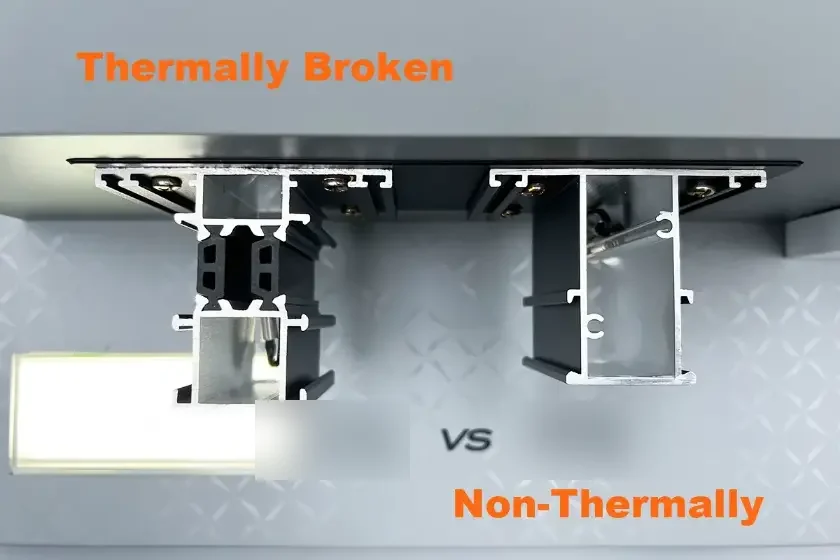
A thermal break is an insulating strip, usually glass-fiber reinforced polyamide, set between the outer and inner aluminum sections of the frame and sash. The two halves are mechanically locked to it, so the frame still acts as one strong piece. Heat has to cross the plastic to get through, and it does that slowly. Better systems use wider strips, several of them, and foam or extra gaskets in the gaps between.
What the frost test shows
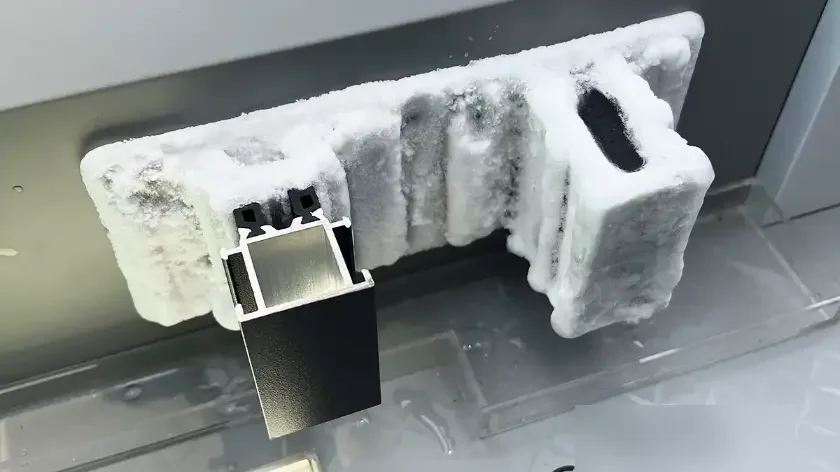
In the photo at the top, both profiles were chilled from one side. The standard aluminum frame is coated in frost all the way through, because the cold traveled straight across the metal. The thermally broken profile in front stays clear on its room side. At home, that cold surface is where condensation forms every winter morning.
Side by side
| Standard aluminum | Thermally broken aluminum | |
|---|---|---|
| Frame | One continuous piece of aluminum | Outer and inner aluminum joined by insulating strips |
| Heat through the frame | High | Much lower |
| Inside frame surface in winter | Close to outdoor temperature | Close to room temperature |
| Condensation and frost on the frame | Common | Much less |
| Energy code for a heated home | Hard to meet | Designed to meet it with the right glass |
| Where it makes sense | Unheated spaces, sheds, very mild climates | Homes and any heated space |
What it means in a Seattle home
Our winters are long, damp and mild, and houses stay closed up, so indoor air holds a lot of moisture. Older aluminum windows from the 1960s to 80s often have no thermal break, and they're the ones that drip on sills, grow mold in corners and feel cold when you sit next to them. A thermally broken frame with triple glass and warm-edge spacers fixes the cold-frame part of that problem. Read more in window condensation in Seattle.
Callout (unattributed): "Plain aluminum takes the outside temperature and brings it into the room. A thermal break stops it at the strip."
Our aluminum windows
Every aluminum window we sell is thermally broken and comes with warm-edge spacers. MB-79N Pro is our value aluminum system and is NFRC certified, with a U-factor from 0.17. SlimLine Elite gives a slim steel look, is NFRC certified and has a U-factor from 0.23. MB-86N handles large, heavy glass, with a U-factor from 0.25 for casements. Your quote lists the rated U-factor for each window. See all aluminum windows.
What is a thermally broken aluminum window?
Do thermally broken aluminum windows still get condensation?
Are thermally broken frames weaker?
How can I tell if my old aluminum windows have a thermal break?
Is thermally broken aluminum as efficient as uPVC?
Related: Aluminum windows · Window condensation in Seattle · Triple-pane glass & options